August 30, 2026
Do You Need a License to Kayak in Florida or California? (2026)
Paddle a kayak and you need nothing. Bolt a trolling motor to it and you have created a registrable vessel — and in California, one that requires a Boater Card. Here is exactly where the line falls in each state.
By Kevin O'Neil
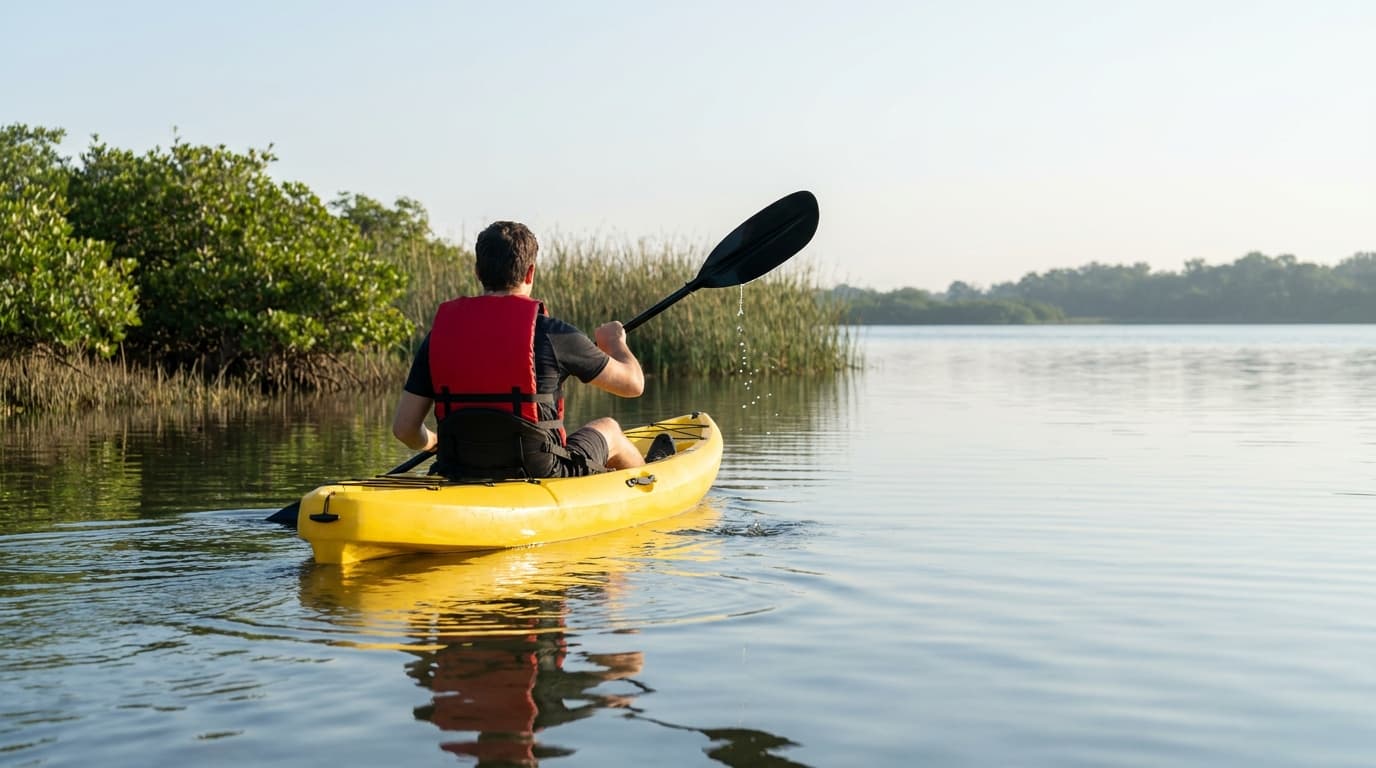
If your kayak is powered by a paddle, the answer is simple: no license, no registration, no boater card — in Florida, in California, and in most of the country. You can buy a kayak this morning and be on the water this afternoon, legally.
The moment you bolt a motor to it, everything changes. And it changes differently in Florida than in California, which is where most paddlers get caught out. This guide covers both states, the exact point where a kayak stops being exempt, and the safety gear you are legally required to carry even when no license is involved.
Paddle-Only Kayaks: No License Anywhere
Boater education requirements in both states attach to motorized vessels. A kayak, canoe, or paddleboard moved by human power is outside the rule entirely.
| Florida | California | |
|---|---|---|
| License or education card | Not required | Not required |
| Registration | Not required | Not required |
| Minimum operator age | None | None |
| Still legally a "vessel" | Yes | Yes |
That last row is the one to remember. Your kayak is a vessel under federal and state law. Navigation rules apply to you. Boating-under-the-influence laws apply to you. And carriage requirements for safety equipment apply to you.
Florida's registration exemption, verbatim
The Florida Fish and Wildlife Conservation Commission puts it this way:
All vessels, with the exception of non-motor-powered vessels less than 16 feet in length, non-motor-powered canoes, kayaks, racing shells or rowing sculls, regardless of length, must be registered.
Read the phrase "regardless of length" carefully. A 19-foot tandem sea kayak is still exempt in Florida, because it is a non-motor-powered kayak. A 15-foot non-motorized jon boat is also exempt, but only because it is under 16 feet.
California's registration exemption
California is stricter, and in one direction people rarely anticipate. Canoes, kayaks, and other vessels propelled by paddles or oars are exempt from registration. So are sailboats 8 feet or less without motors. But a sailboat over 8 feet must be registered with the DMV even with no motor at all — and any vessel with a motor must be registered regardless of size.
Add a Motor and the Rules Change
This is the heart of it. A trolling motor turns your kayak into a motorized vessel, and the two states respond differently.
Florida: register it, but the education card usually is not triggered
Once your kayak is motor-powered it falls outside the exemption above, so it must be registered with your county tax collector and display the registration numbers and decal.
The education card is a separate question with a separate threshold. Florida's requirement applies to a vessel "powered by a motor of 10 horsepower or greater." A typical electric trolling motor — rated in pounds of thrust, and equivalent to well under one horsepower — falls far below that line. So the usual outcome for a trolling-motor kayak in Florida is: registration yes, education card no.
If you hang a gas outboard of 10 hp or more on a skiff or a larger kayak and you were born on or after January 1, 1988, the card becomes mandatory. Our Florida requirements guide covers that case.
California: register it, and get the Boater Card
California draws no horsepower line for the Boater Card. The requirement covers operating a motorized recreational vessel on state waterways, and since January 1, 2025 it applies to all persons regardless of age.
So a trolling motor on a kayak in California means both DMV registration and a California Boater Card. The card is $10 from the Division of Boating and Waterways, never expires, and requires an approved course — California mandates that approved online courses run a minimum of three hours.
| Kayak with a trolling motor | Florida | California |
|---|---|---|
| Must register | Yes | Yes |
| Boater education card | Only if motor is 10 hp or greater | Yes — any motor |
| Card cost | Course only | $10 state fee + course |
Safety Equipment You Must Carry Regardless
No license does not mean no rules. Because a kayak is a vessel, carriage requirements apply.
Life jackets
- One wearable, Coast Guard–approved PFD per person aboard, in serviceable condition and the right size. This is federal and applies to paddlecraft.
- Florida: children under 6 must wear a PFD on a vessel under 26 feet while underway — which is every kayak.
- California: stricter. Under Harbors and Navigation Code 658.3, every child under 13 on a moving recreational vessel of any length must wear a Coast Guard–approved life jacket. Narrow exceptions cover an enclosed cabin, a harness on a sailboat, and emergency rescues — none of which apply to a kayak.
Inflatable PFDs are popular with paddlers for comfort, but check the label: many are approved only for adults and are not accepted for children.
Sound and light
- A sound-producing device. A whistle on your PFD zipper satisfies this and costs a few dollars.
- A white light if you paddle between sunset and sunrise, ready to display in time to prevent a collision. A headlamp is the standard solution.
These two items are where paddlers most often fail a stop, and both fit in a pocket.
Rules That Apply to You Even Without a License
- Boating under the influence. A kayak is a vessel. Florida's BUI threshold is 0.08, the same as driving, and it applies to paddlers.
- Navigation rules. You are obligated to keep a proper lookout and avoid collisions. In practical terms a kayak is nearly invisible to a bass boat at speed — assume you have not been seen.
- Reckless operation and accident reporting. Both apply to paddlecraft.
- Local restrictions. Manatee zones, wildlife refuges, and spring runs in Florida carry access rules that apply specifically to paddlers.
Where People Get Caught
- Buying the trolling motor and forgetting registration. The motor makes it a registrable vessel the day you mount it, in both states.
- Assuming California mirrors Florida's 10 hp rule. It does not. Any motor triggers the California Boater Card.
- Carrying PFDs in the hatch. "Carry" means accessible, not stowed under a bungee behind a sealed cover. For children, they must be worn.
- Paddling back at dusk with no light. The most common paddlecraft citation, and the most common paddlecraft fatality factor.
- Thinking a sailboat is like a kayak in California. Over 8 feet, it needs registration even with no engine.
Frequently Asked Questions
Do you need a license to kayak in Florida?
No. Non-motor-powered kayaks and canoes require no license, no boater education card, and no registration, regardless of length.
Do you need a license to kayak in California?
No. Paddle-propelled kayaks and canoes are exempt from registration and from the California Boater Card, which applies only to motorized vessels.
Do I need to register a kayak with a trolling motor?
Yes, in both Florida and California. Adding any motor removes the paddlecraft exemption.
Does a trolling motor mean I need a boater card?
In California, yes — the card applies to any motorized recreational vessel. In Florida, generally no, because the requirement starts at 10 horsepower and trolling motors are far below that.
Is there a minimum age to kayak?
Neither state sets a minimum age for paddling. Child life jacket rules do apply — under 6 in Florida, under 13 in California.
Can I get a BUI in a kayak?
Yes. A kayak is a vessel and boating-under-the-influence laws apply.
If You Are Adding a Motor
Paddling stays licence-free, and that is unlikely to change. But the trolling-motor kayak has become the fastest-growing category in paddlesport, and it quietly moves you into the registered-vessel world. If you are in California, that means the Boater Card course and a $10 card that lasts a lifetime. In Florida, register the boat — and if you are ever likely to run something with 10 horsepower or more, the lifetime course is a one-time $39.97 that never needs renewing.