August 30, 2026
Boating Over 60: Do Seniors Need a Boating License? (2026)
Florida almost certainly does not require you to hold a boater education card. California almost certainly does. Same boat, same operator, opposite obligations — plus the 60-day rule that catches seasonal residents every winter.
By Kevin O'Neil
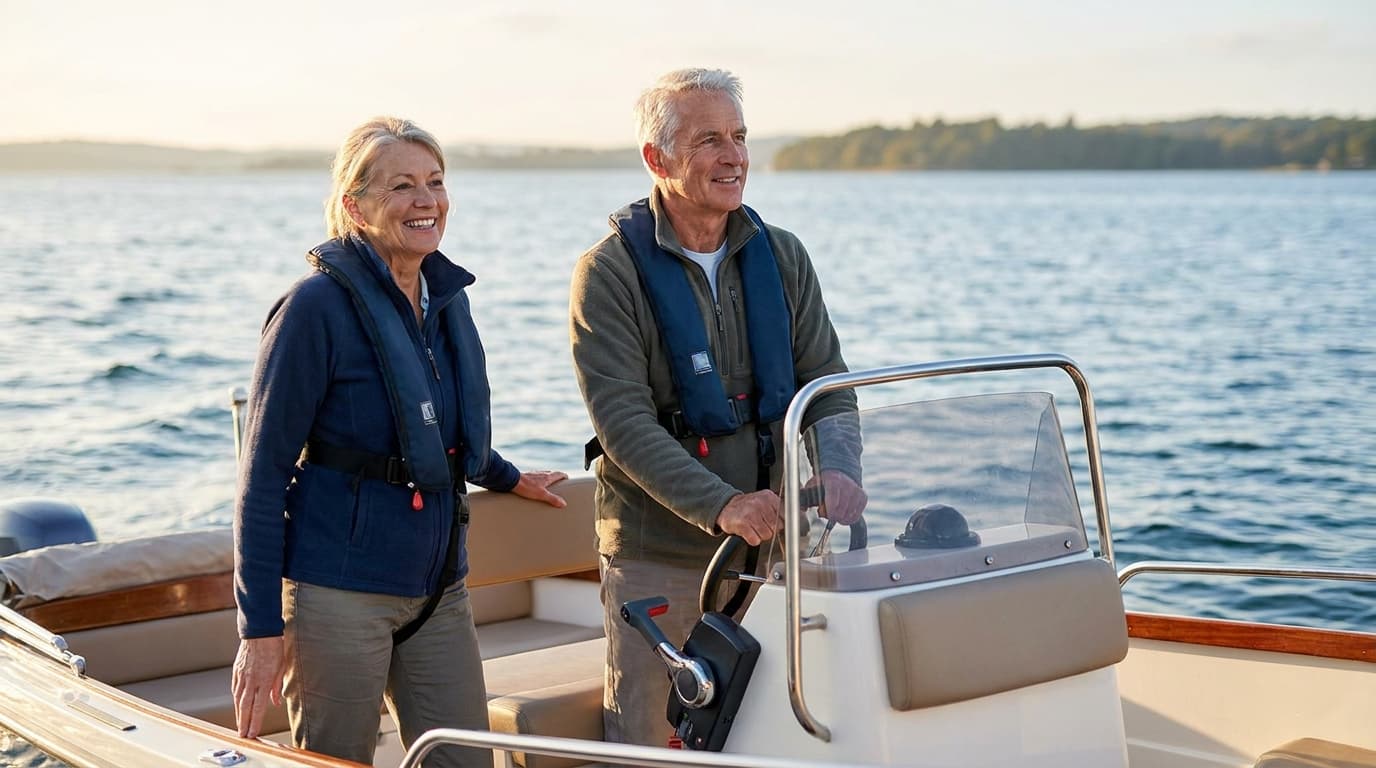
If you are over 60 and boat in both Florida and California, you are living under two opposite rules. Florida almost certainly does not require you to hold a boater education card. California almost certainly does. Same boat, same operator, completely different obligation — and the reason has nothing to do with your age or experience.
This guide explains where older boaters stand legally in each state, the snowbird trap that catches seasonal residents every winter, and the practical safety adjustments that matter most after 60.
Florida: Most Boaters Over 60 Are Exempt
Florida's requirement is tied to a birth date, not an age. Under Florida Statute 327.395, a person born on or after January 1, 1988 may not operate a vessel powered by a motor of 10 horsepower or greater without a Boating Safety Education Identification Card.
Because the cutoff is fixed and the calendar keeps moving, the exempt group grows every year. In 2026, anyone turning 39 or older was born before that date and needs no card. Every boater over 60 in Florida is comfortably exempt.
Florida's rule is a fixed line in history, not a rolling age test. It will still say January 1, 1988 in 2040.
You still need photo identification aboard, and every other Florida boating law — registration, life jackets, navigation lights, no-wake zones, BUI — applies exactly as it does to a 25-year-old.
California: Every Age Now Needs the Card
California went the other direction. The Boater Card was phased in by age group beginning in 2018, adding an older bracket each year. The schedule in Harbors and Navigation Code 678.11(b) finished on January 1, 2025: all persons, regardless of age.
| Phase-in date | Who became subject to the requirement |
|---|---|
| January 1, 2018 | Persons 20 or younger |
| January 1, 2022 | Persons 45 or younger |
| January 1, 2024 | Persons 60 or younger |
| January 1, 2025 | All persons, regardless of age |
There is no senior exemption. A 78-year-old who has run boats on the Delta since the 1960s needs the same card as a teenager. If you operate a motorized recreational vessel on California waterways and you are a California resident, you need it.
What it costs and how long it lasts
The card is $10 from the Division of Boating and Waterways, with a replacement fee of no more than $5, and once issued it is valid for the holder's lifetime. You need an approved course first — California requires approved online courses to run a minimum of three hours. Our California boater safety course is $39.97 and you can take it in as many sittings as you like.
The Snowbird Trap
This is the single most common mistake among older boaters, and it costs people money every winter.
California exempts a resident of a state other than California who is temporarily operating a vessel in California for less than 60 days and who meets the boating requirements, if any, of their home state. Read "less than 60 days" carefully.
- A Michigan retiree who spends three weeks boating in San Diego each spring is exempt.
- A Michigan retiree who spends November through March in San Diego is well past 60 days and needs the California Boater Card — even though they are exempt in Florida and require nothing at home.
The reverse trip is easier. Florida accepts a NASBLA-approved course completion from another state, and if you were born before 1988 you needed nothing in Florida to begin with.
What happens if you are cited in California
Operating without the card when required is an infraction under Harbors and Navigation Code 678.15: up to $100 for a first conviction, $250 for a second, and $500 for a third or subsequent. Two details worth knowing — the fine is waived if you can prove you actually held a valid card at the time of the citation, and the court will order you to complete an approved course anyway. You take the course either way; the only question is whether you also pay.
Quick Reference
| Your situation | Florida | California |
|---|---|---|
| Resident, age 60+, own a motorboat | No card needed | Card required |
| Renting a boat | No card needed (born before 1988) | Exempt — rental vessels |
| Visiting under 60 days | No card needed | Exempt |
| Seasonal resident, 60+ days | No card needed | Card required |
| Paddling a kayak or canoe | No card needed | No card needed |
Why Many Exempt Florida Boaters Take the Course Anyway
Being exempt is not the same as being current. A boater who learned in 1975 has never been formally taught several things that are now routine:
- Engine cut-off switches. Since April 1, 2021, federal law requires operators of recreational vessels less than 26 feet to use the engine cut-off switch and its link. Many lifelong boaters still leave the lanyard coiled on the dash.
- Modern PFD types, including inflatables that did not exist when most seniors learned.
- Changed navigation aids and VHF procedures, including DSC distress calling.
- Insurance discounts. Many carriers reduce premiums for certified operators — over a few seasons the course can pay for itself.
If you boat in both states, one course solves both problems: it satisfies California and refreshes Florida. Our NASBLA approval is what makes the certification portable.
Safety Adjustments That Matter After 60
None of this is legally required. All of it is worth doing.
Re-boarding is the real risk
Falling in is survivable. Getting back aboard often is not. Upper-body strength declines faster than most people expect, and pulling yourself over a gunwale in wet clothes is far harder than it looks. Fit a boarding ladder you can deploy from in the water — many transom ladders can only be lowered from on deck, which is useless to a person overboard alone.
Wear the life jacket, and pick the right kind
The argument against wearing one is almost always comfort. Modern inflatable belt-pack and suspender PFDs remove that objection almost entirely. If you have any mobility or shoulder limitation, choose a jacket you can right yourself in — some inflatables require you to be conscious and able to assist.
Medication, heat, and dehydration
Many common prescriptions — diuretics, beta blockers, antihistamines, blood thinners — interact badly with sun, heat, and dehydration. Diuretics in particular accelerate fluid loss on a Florida afternoon. Bring more water than you think you need, keep shade available, and check labels for photosensitivity warnings before a full day out.
Cold water is a California problem
California's ocean water and its high-elevation lakes stay cold year-round, and cold water shock causes an involuntary gasp and rapid loss of hand function within minutes. That progression is faster and less survivable with age and with cardiac conditions. A worn life jacket is what buys you the time.
Night vision and hearing
Low-light vision declines steadily after 50, and picking out an unlit channel marker at dusk is genuinely harder than it was. Plan to be back at the dock before sunset where you can, and if you cannot, slow down well below what feels necessary.
Always leave a float plan
Tell someone ashore where you are going and when you will be back. It costs nothing and it is the single thing that most reliably shortens a search.
Frequently Asked Questions
Do seniors need a boating license in Florida?
No. Florida's requirement applies only to people born on or after January 1, 1988. Every boater over 60 is exempt.
Is there a senior exemption for the California Boater Card?
No. Since January 1, 2025 the requirement applies to all persons regardless of age.
I am 70 and have boated for 50 years. Do I still need the California card?
Yes, if you are a California resident operating a motorized recreational vessel. Experience is not an exemption.
I winter in California but live elsewhere. Do I need it?
If you operate here for 60 days or more, yes. Under 60 days you are exempt, provided you meet your home state's requirements.
Does the California Boater Card have to be renewed?
No. It is valid for the holder's lifetime once issued.
Is there an age at which the requirement stops?
No. Neither state has an upper age limit or a retirement provision.
Where to Start
If you boat in California, the card is not optional any more — take the course, pay DBW $10, and it is settled for life. If you boat only in Florida and were born before 1988, you are legally clear; the lifetime course is worth considering anyway for the insurance discount and the refresher on rules that have changed considerably since most of us learned.